
German vs Japanese Cars in Cyprus: Which One Really Costs Less to Own?

Updated: Sep 17
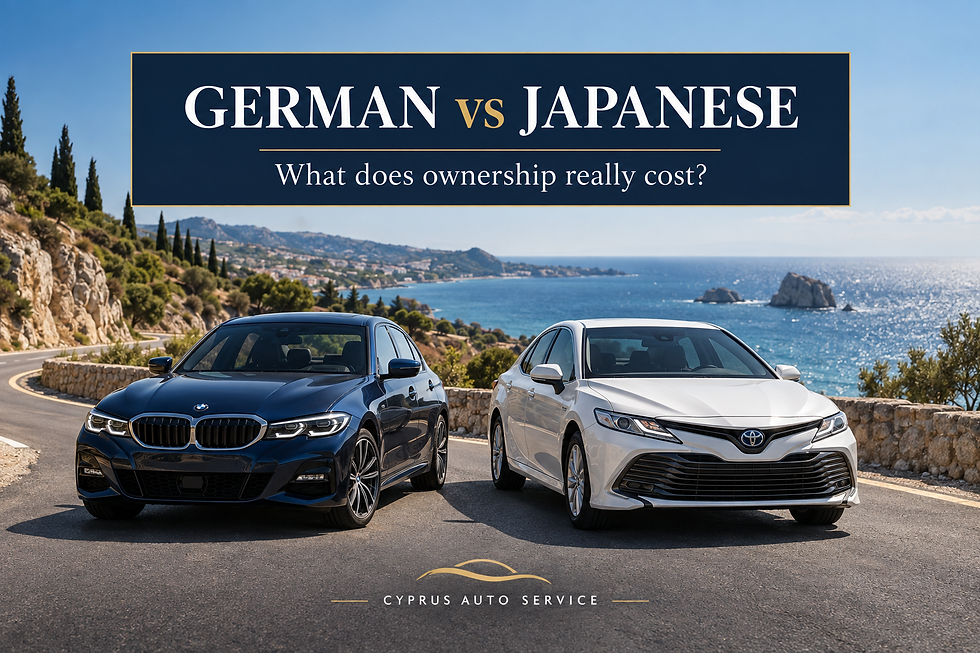
A German badge still turns heads on Cyprus roads. But after years of importing cars from Japan for drivers across the island, I keep having the same honest conversation: the car that looks like the premium choice in the showroom is often the one that quietly drains your wallet for the next five years. Before you sign for that German saloon, let us compare what actually matters - the total cost of owning the car, not just the price on the windscreen.
The real question is total cost of ownership, not the badge
Every car has two prices: what you pay to buy it, and what you pay to keep it running. On the first, German and Japanese cars can look similar. On the second - parts, servicing, repairs and resale value - they are worlds apart. In Cyprus, where heat, salt air and long distances punish every car, that second price decides whether you made a smart buy or an expensive mistake.
German cars: the sticker price is only the beginning
Modern German cars are engineered beautifully - and increasingly locked down. The trend across the big German brands is to keep the owner tied to the official dealer network for as long as possible. In practice that means:
Coded, chipped parts that will not activate unless the official dealer enables them.
Software updates and feature activations only through the local dealer, not an independent garage.
Comfort features moving to paid subscriptions - pay monthly to keep what used to be built in.
Fewer independent workshops able to service newer models, so you have little choice on price.
None of this shows on the test drive. It shows up two years later, when a routine job costs like a small holiday. For the wider picture of what an import really costs versus a local showroom car, see importing from Japan vs a Cyprus dealership.
Cyprus makes an expensive car even more expensive
Now add the island. Strong sun ages interiors, electronics and batteries faster; salt air attacks bodywork and connectors; city traffic means constant stop-and-go wear. A complex German car in these conditions does not get cheaper over time - it gets dearer, and every specialist repair is priced accordingly. Reliability stops being a nice-to-have and becomes the whole game.

Japanese cars: boring in the best possible way
A good Japanese car is like a calm, reliable partner - no surprises, no subscriptions, no "sorry, that can only be done at the dealer." For most drivers in Cyprus that is exactly what you want:
Reliability proven over decades, with simpler, tougher mechanics.
Affordable, widely available parts - and no activation games.
Any competent local garage can service it, so you control the price.
Strong resale value, because buyers trust Japanese cars.
Predictable running costs you can actually plan around.
Premium is not only a German word either: a Lexus from Japan gives you real luxury and hybrid refinement with Toyota reliability underneath and none of the dealer-lock drama. It is why so many islanders now skip the showroom - the full reasoning is in why smart buyers choose cars from Japan, not the dealership.
What we recommend as importers
Look beyond the purchase price: compare the exact model, engine, service history, condition and expected running costs. Browse Japanese cars and auction options on BuyCarInCyprus, and check available Japanese auction history on CarsFromJapan. A history report complements a physical inspection; it does not replace one. For the import steps, see our Japan-to-Cyprus ordering guide. Buying locally? Read how to buy without hidden problems.
FAQ - German vs Japanese cars in Cyprus
Are Japanese cars cheaper to own than German cars in Cyprus?
For most drivers, yes. The purchase price can be similar, but Japanese cars usually win on the costs that matter in Cyprus: cheaper parts, lower servicing, fewer breakdowns and stronger resale value. Over a few years that difference is often thousands of euros.
Why is servicing German cars so expensive?
Parts are pricier, the electronics are more complex, and more jobs now need the official dealer or special equipment because of coded parts and software locks. That pushes up the long-term cost of ownership, especially outside the main cities.
Is it worth importing a Japanese car instead of buying locally?
Very often, yes. With a proper auction-sheet check, a clear final price and a reliable process, importing an almost-new Japanese car can give you a better car for less money than a comparable local one - delivered turnkey.
Which is more reliable, a German or a Japanese car?
Japanese cars are famous for reliability thanks to proven engines and simpler mechanics, which usually means fewer faults and lower repair costs over time. German cars can be excellent but tend to be more complex and costly to keep in top condition.
Ready to choose the smart way?
Tell us the German model you are considering and your budget, and we will show you the Japanese alternative that costs less to own - with the auction sheet and a clear final price in euros. Message us on WhatsApp and let's find your car in Japan.




Comments